
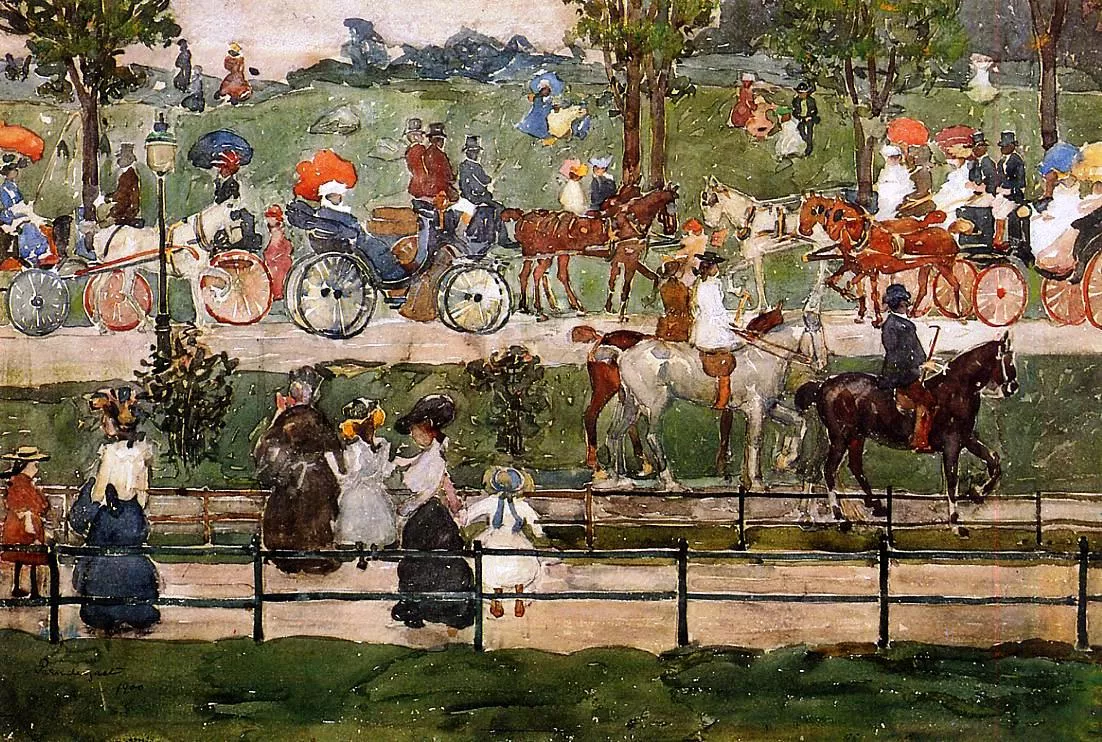
I have seen this painting three times, and each time it has taken me a different amount of time to find the crowd. That is not a comment on my eyesight. It is a comment on how Prendergast built the sheet. Central Park, watercolour and graphite on paper, 1900, is in the Whitney's permanent collection. From the door of the gallery, it reads as a scene. From two metres away it falls apart into small dots of colour. From close up it is almost abstract, and if you did not know what you were looking at, you could mistake it for a study of confetti.
What I keep coming back to is the crowd. Prendergast painted it the way a mosaicist lays tiles, one dab at a time, and then he let the dabs speak for themselves. The people are there, in a technical sense — parasols, hats, dresses, a dog somewhere near the lower left — but none of them have faces, and none of them are doing anything specific. They are the pattern. The pattern carries the picture. That shift is what makes him modern, and it is the reason a print of this painting cannot hold what the original holds.
Where He Learned to See in Dabs
Prendergast was born in St. John's, Newfoundland, in 1858. His family moved to Boston when he was ten. He worked as a commercial artist for greeting card companies into his thirties, which by the standards of the Boston art world at the time was late to be starting, and then in 1891 he left for Paris and stayed four years. He studied at the Académie Julian and the Académie Colarossi, both of them standard training grounds for young painters, and neither of them appears to have made much of an impression on him. What did: the Japanese prints he saw in the galleries, the work of the Nabis, and — this is the part I find most useful for understanding the technique — Paris itself, which he painted in small notebooks the way a diarist writes entries.
His brother Charles was also a painter, and the two of them travelled together to France and Italy in the 1890s. Charles's work is heavier, more anchored in post-impressionist structure. Maurice went the other direction, and by the time he came back to Boston he had a method no American painter was using. He did not model figures with shadow. He layered them out of flat patches of colour and let the edges of the patches describe the shape. The technique belongs closer to tapestry than to oil painting, and it depends on watercolour for a practical reason: watercolour dries fast enough that you can lay down one dab, wait a moment, and put down the next one before the paper buckles.
 Central Park, 1900. Watercolour and graphite on paper. Whitney Museum of American Art, New York. Source: Wikimedia Commons (public domain).
How the Painting Is Actually Built
Take the band of trees along the upper edge. There are, by my count, roughly forty separate small strokes in that band. Dark greens, pale greens, grey-blues, a few touches of ochre. He could have done the whole thing with one green wash in a single movement, and it would have taken him ten seconds. He chose forty strokes instead. A single wash would have been a shape, and a shape describes something. Forty strokes describe nothing except a rhythm. That rhythm is what your eye reads as trees.
Now the figures. Each one is two or three dabs, occasionally four. A dab for the dress, a dab for the hat, a dab for the parasol. The parasols carry the composition. There are red ones, blue ones, yellow ones, and each one is a small disc that pulls the eye across the crowd the way a magnet pulls iron filings. Strip the parasols out and the whole sheet goes green and grey and flat. Keep them in, and the picture flickers.
The paper underneath is visible in several places. The pale strip of path along the bottom edge, for instance — that is the paper, not a wash of pale ochre. The sky at the top, the same. Prendergast did not fill the sheet. He let the paper do the work of the light, and he placed his dabs only where the pattern needed them. If you look at his Paris notebooks, you can see the same habit forming in real time: he leaves more and more of the page open as the notebooks progress.
Why Watercolour and Not Oil
He worked in both, but the watercolours are where the technique actually lives. Oil lets you build up slowly and blend two colours into one, so that light and shadow pass into each other without a border. Prendergast did not want that. He wanted visible edges. Visible edges are what creates the mosaic, and watercolour, which cannot be layered repeatedly without going muddy, forced him to lay each colour down once and move on.
By the late 1890s he was painting the same scenes in oil too, applying the same mosaic logic in a denser medium. The oil versions are heavier and more emphatic, with bigger dabs, and they sit somewhere between the watercolours and the more abstract work he made after 1910. Whether the oils are better is a matter of taste. I find the watercolours truer to the idea, because the medium itself is part of the argument. The lightness of the paper is doing as much work as the colour.
Why a Print Loses the Flicker
Digital printing cannot reproduce the layered rhythm of a watercolour mosaic. The colours print with equal density, so the dabs that Prendergast placed one after another collapse into a single flat texture. The paper showing through in the pale passages, which gives the original its breathing quality, disappears into a uniform white. The parasols lose their pull, because the printed image cannot distinguish between a pale red dab that catches the light and a pale red dab that sits in shadow.
A hand-painted reproduction is built the way Prendergast built the original. The dabs are laid down one by one, in order, at the same scale. The paper or ground is allowed to show through where the original lets it show through. The parasols are painted last, so they sit on top of the crowd the way they sit on top of it in the original. The result is a surface that flickers the way the original flickers, because each dab of colour is a real dab of colour, applied by hand.
See Central Park as a hand-painted reproduction at oilpaintings.com. The mosaic is rebuilt dab by dab, in the same rhythm Prendergast used. View the painting
 A hand-painted reproduction, built dab by dab in the order Prendergast worked. The paper is allowed to show through where the original lets it show through.
What to Look For
Start at the parasols. Count them, if you want, and notice that each one is a slightly different colour. Then look at the path along the bottom. See that the paper is doing the work of the light, and that no line describes the path. Then step back. The crowd will reassemble, and the mosaic will read as a scene.
In 1908 Prendergast exhibited with The Eight, the group of American painters who broke with the National Academy of Design and put on their own show at the Macbeth Galleries. He was the only watercolourist in the group, and the only one whose subject was leisure rather than factories or tenements or the darker side of the city. A critic at the time — I have not been able to trace which one, though the line gets quoted often — wrote that the paintings were "decorative." He meant it as a criticism. What he missed was that decoration was the point. The pattern was the subject and Prendergast had already begun painting what the next generation of American modernists would spend their careers trying to reach.
Images: Wikimedia Commons (public domain) and Maurice Brazil Prendergast (mauricebrazilprendergast.com).